
By Maame Awinador-Kanyirige
Introduction
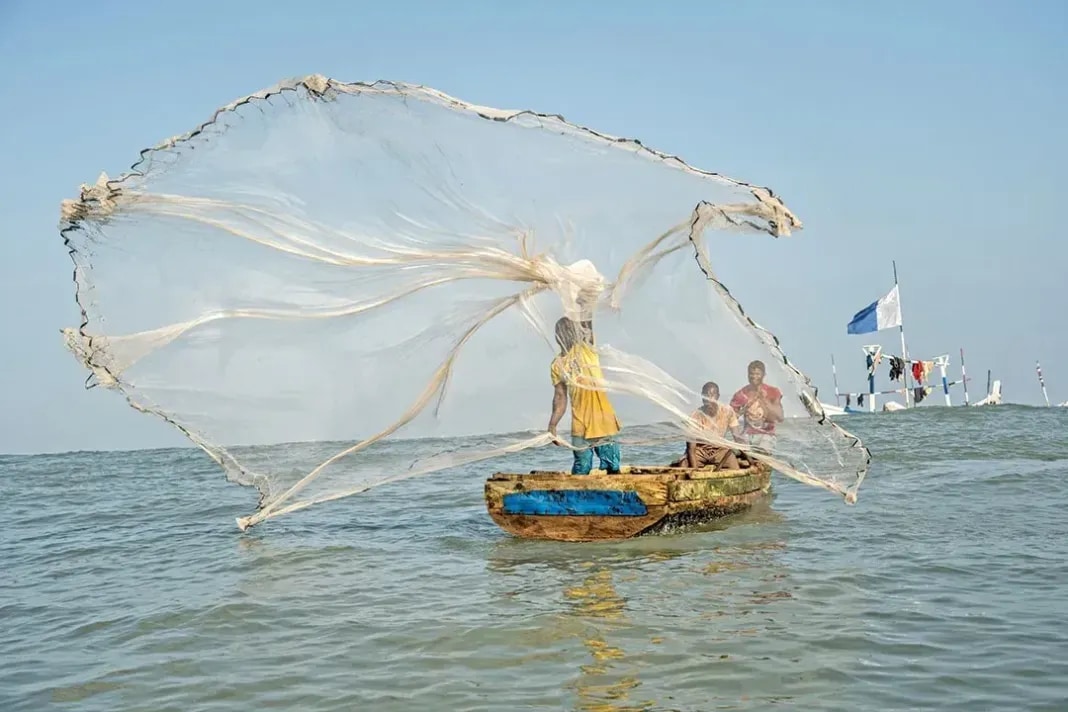
At first light, along the coast of West Africa, the scene still looks familiar: canoes slide into the water, nets are cast, and fishers head out as their fathers and grandfathers once did. But beneath that familiarity, the sea is changing.
Across the Gulf of Guinea from Côte d’Ivoire through Ghana, Togo, and Benin to Nigeria the marine environment is under growing pressure from warming waters, shifting currents, and stressed coastal ecosystems.
What was once a relatively predictable fishing ground is becoming a moving corridor shaped less by fixed geography than by climate and ecology. Fish are shifting eastward, moving deeper, and drifting away from the communities that depend on them.
This is more than a fisheries story; it is a food security story, an economic story, and a regional governance story. Research suggests that warming is weakening coastal upwelling in the northern Gulf of Guinea, reducing the nutrient supply that supports fisheries.
At the same time, marine heatwaves are becoming more frequent globally; a 2026 Reuters summary of UN agencies reported that 91% of the world’s oceans experienced at least one marine heatwave in 2024. In the Gulf of Guinea, these shifts are not abstract scientific trends they are already changing how people eat, work, trade, and survive.
The changing ocean and the shrinking catch
For decades, the ocean along this corridor followed a seasonal rhythm that coastal communities understood well. Cold, nutrient-rich waters rose through upwelling, feeding the marine food chain and sustaining abundant catches. That pattern is now under strain. Research on the northern Gulf of Guinea indicates that coastal upwelling intensity is weakening under global warming, reducing the nutrient supply that fish stocks depend on.
The impact is often felt first in small but painful ways: catches fall, fishers stay at sea longer, and fuel costs rise. Distances grow, returns shrink, and the strain spreads through the value chain. Over time, those incremental losses become a broader crisis. Markets turn less predictable, prices climb, and households that rely on fish for daily protein struggle to afford what was once a staple. What begins as an environmental shift quickly becomes an economic and social one.
The challenge is compounded by the fact that fish do not recognize national borders. As stocks migrate across Exclusive Economic Zones, the logic of purely national fisheries management begins to break down. This phenomenon highlights what legal scholar Yoshifumi Tanaka describes as the tension between the “law of divided oceans” (state sovereignty) and the “law of our common ocean” (resource conservation). Under the UN Convention on the Law of the Sea (UNCLOS), states have a formal “duty to cooperate” regarding straddling and highly migratory stocks a legal obligation that becomes a survival necessity as climate change accelerates stock migration.
Species once associated with one coastline now appear along another not because of politics, but because ocean conditions are changing. A 2025 Harvard-linked study found that small pelagic fish declined by 59% in Ghana between 1993 and 2019 and by nearly 40% in Côte d’Ivoire between 2003 and 2020, with ocean warming and illegal fishing both contributing to the pressure. One country’s loss may look like another’s gain, but only briefly; in reality, the entire region is adjusting to the same disruption.
Why this matters for food security
The pressure is visible across the corridor. In Nigeria, WorldFish reports that the country produces about 1.2 million metric tons of fish annually yet spends about $1 billion a year on imports to cover roughly 45% of supply. In Ghana, FAO’s market profile shows fish available for consumption at 23.6 kilograms per person. In Côte d’Ivoire, FAO reported that in 2023 the country produced about 92,000 tonnes of fish but consumed around 534,000 tonnes making fish the leading source of animal protein while still leaving a large import gap. Togo and Benin face similarly sharp imbalances, with low domestic production and heavy dependence on imports.
This matters because fish is not a luxury food. For billions of people, it is a major source of protein and essential nutrients. Research cited by Harvard estimates that declining seafood access could leave hundreds of millions vulnerable to micronutrient deficiencies, including shortages linked to vitamin B12, iron, and zinc. In West Africa where fish is often among the most affordable and accessible animal proteins the consequences of scarcity are immediate: weaker diets, tighter household budgets, and deeper food insecurity.
Seen this way, the Gulf of Guinea becomes more than a regional concern. It is a window into a broader global reality: climate change is reshaping where food comes from, who can access it, and how resilient food systems really are. Declining fish stocks affect fishers first, but the effects ripple outward to traders, processors, transporters, consumers, and governments. They reshape prices in local markets and planning in national ministries. A coastal disruption becomes a regional issue, and a regional issue becomes part of the global food security conversation.
The case for regional action
That is why the response must be equally broad. The old model of fisheries management assumed that each country could manage its waters independently, but that assumption no longer holds. If fish move across borders, protection must move across borders too. If illegal fishing exploits gaps in surveillance, enforcement must be coordinated. If overfishing in one area undermines recovery in another, closed seasons must be synchronized rather than isolated.
This is where regional cooperation becomes not just useful, but necessary. The Fisheries Committee for the West Central Gulf of Guinea (FCWC), created under the Cotonou Convention in 2007, provides an institutional platform for this kind of collaboration. Tanaka identifies this as the “institutionalization of cooperation,” where regional bodies bridge the gap between national law and the ecological reality of the sea.
In April 2026, FCWC and the European Fisheries Control Agency carried out the first regional joint fisheries surveillance patrol across the EEZs of Ghana, Côte d’Ivoire, and Liberia under the West Africa Sustainable Oceans Programme. FCWC also reports that a second joint patrol is being considered, potentially involving Togo, Benin, and Nigeria. In other words, the region is beginning to govern the sea the way the sea behaves as one connected system.
The way forward
The way forward is not to choose between conservation and development, but to build both into a single strategy. A coordinated closed season across the corridor would give fish stocks a better chance to recover along their migration routes.
To support these modern policies, the sub-region can look to its own indigenous historical methods as a foundation for compliance and management:
- The “Tuesday Ban”: For generations, coastal communities in Ghana and Togo have observed traditional “fishing holidays” (such as not fishing on Tuesdays). Historically, these were spiritual observances, but ecologically they functioned as consistent, community-enforced “micro-closed seasons” that allowed the sea to rest.
- The Apofohene (Chief Fisherman): This traditional institution historically managed communal resources, adjudicated disputes, and enforced gear restrictions. Re-integrating these leaders into modern “co-management” frameworks can ensure that regional strategies are respected at the local landing site.
- Sacred Sanctuaries: Historical taboos once protected specific lagoons and mangrove forests as sacred spaces, effectively creating some of the world’s first Marine Protected Areas (MPAs).
Joint surveillance would reduce opportunities for illegal, unreported, and unregulated fishing. Investment in cold-chain systems and processing infrastructure would reduce post-harvest losses and help communities capture more value from each catch. FAO-linked commentary on Africa’s cold chain notes that roughly 20% to 30% of fish in sub-Saharan Africa is lost before it reaches consumers, largely because landing sites often lack refrigeration and reliable ice systems.
Aquaculture is another important buffer. Côte d’Ivoire has made it a national priority, aiming to raise production from 8,467 tonnes in 2023 to 500,000 tonnes a year by 2030. Such investment will not replace wild capture fisheries, but it can reduce pressure on them and help close the growing protein gap.
Then there is the shore itself. Mangrove restoration may sound like a conservation story, but in the Gulf of Guinea it is also a fisheries story. FAO notes a direct relationship between mangrove health and the renewal of fish stocks, and reports that in Côte d’Ivoire and Senegal, 60 hectares of mangroves were restored and a further 290 hectares in each country were placed under protection in 2020–2021. In Côte d’Ivoire’s Sassandra-Dagbého area, a 3,243-hectare mangrove forest shrank by 10% between 2000 and 2020. Protecting these ecosystems means protecting the nursery grounds that future fish stocks depend on.
Conclusion
The Gulf of Guinea is teaching a lesson that reaches far beyond West Africa. The ocean is no longer a fixed space defined by borders; it is a living system defined by movement of heat, currents, fish, trade, and risk. The future of fisheries will depend not only on who controls territory, but on who can manage a shared ecosystem with shared purpose.
If the countries of the corridor can move from competition to coordination, from fragmented policy to regional strategy, and from extraction to resilience, the Gulf of Guinea may yet become a model for how coastal regions adapt to climate change without surrendering their food security. In a warming world, the survival of communities at the water’s edge will depend on more than the ability to fish it will depend on the ability to cooperate.
Discover more from The Business & Financial Times
Subscribe to get the latest posts sent to your email.