
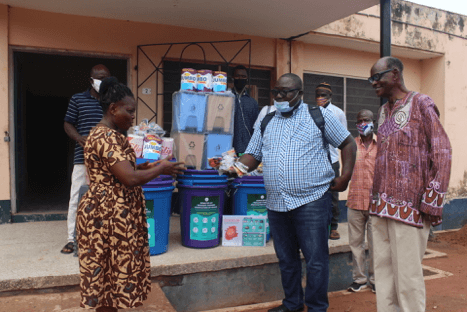
COVID-19: PFAG is working to keep farmers safe

Published by Benson Arthur
70 views
Topics in this article
Personal Protective Equipment (PPE)World Health Organisation (WHO)Peasant Farmers Association of Ghana (PFAG)Agric Extension OfficersInternational Budget Partnership (IBP)Ghana Federation of Forest and Farm Producers (GhaFFaP)
Related Coverage: Agribusiness

Mining
Rethink mining concessions, tax incentives to boost revenue – IFS
Government must overhaul its mining revenue framework, strengthen enforcement against revenue leakages and review tax incentives to raise domestic revenue, the Institute for Fiscal Studies (IFS) has said, warning that weak revenue mobilisation is constraining public investment and deepening fiscal pressures.
Business and Markets
BoG pushes tech-driven credit access for underserved businesses
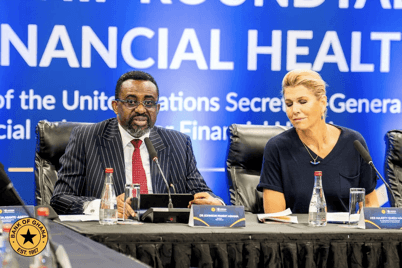
The Bank of Ghana (BoG) is pushing technology-driven solutions that expand access to productive credit for underserved businesses, as it seeks to translate the country’s financial inclusion gains into stronger financial health for households and enterprises.

Economy
IMF backs 2027 fiscal plan amid external risks
The International Monetary Fund (IMF) has backed Ghana’s 2027 fiscal strategy targetting a 0.5 percent of gross domestic product (GDP) primary surplus, while urging tighter spending controls to protect debt sustainability and preserve room for job creation and infrastructure investment.

News
Industrial research can narrow US$8.9bn trade gap with China - CSIR-IIR
The newly appointed Director of the Council for Scientific and Industrial Research-Institute of Industrial Research (CSIR-IIR), Dr. William Owusu Oduro, has called for stronger industrial capacity to address trade imbalances with other countries, particularly China.

Banking & Finance
Fidelity Bank achieves 2X Certified Advanced Status for Gender-Smart Finance
Fidelity Bank Ghana has achieved 2X Certified Advanced status, becoming the only bank in Ghana to attain this distinction and reinforcing its commitment to advancing gender-smart finance and women's economic empowerment.

Banking & Finance
ADB Ghana Medicals, Philips partnership to advance tech-driven healthcare
ADB Ghana Medical Systems Group Ltd. and Philips Healthcare of the Netherlands have reaffirmed their commitment to building a strong and sustainable strategic partnership aimed at advancing healthcare delivery in Ghana.

Features
When Agreement Becomes a Liability.
Consensus can make an institution comfortable. Its capacity to examine disagreement may be what makes it sustainable.

Banking & Finance
Trade readiness key to helping businesses access global markets – Stanbic
Ghanaian businesses seeking to expand beyond the domestic market need more than access to finance; they require the knowledge, networks and market connections to compete effectively in international trade, Stanbic Bank Ghana has said.
Comment guidelines
Please keep comments respectful. Use plain English for our global readership and avoid using phrasing that could be misinterpreted as offensive. By commenting, you agree to abide by our community guidelines and these terms and conditions. We encourage you to report inappropriate comments.
No comments yet. Be the first to share your thoughts.